

Bridging the Gap Between AI and Reality: Introducing tytec.ai
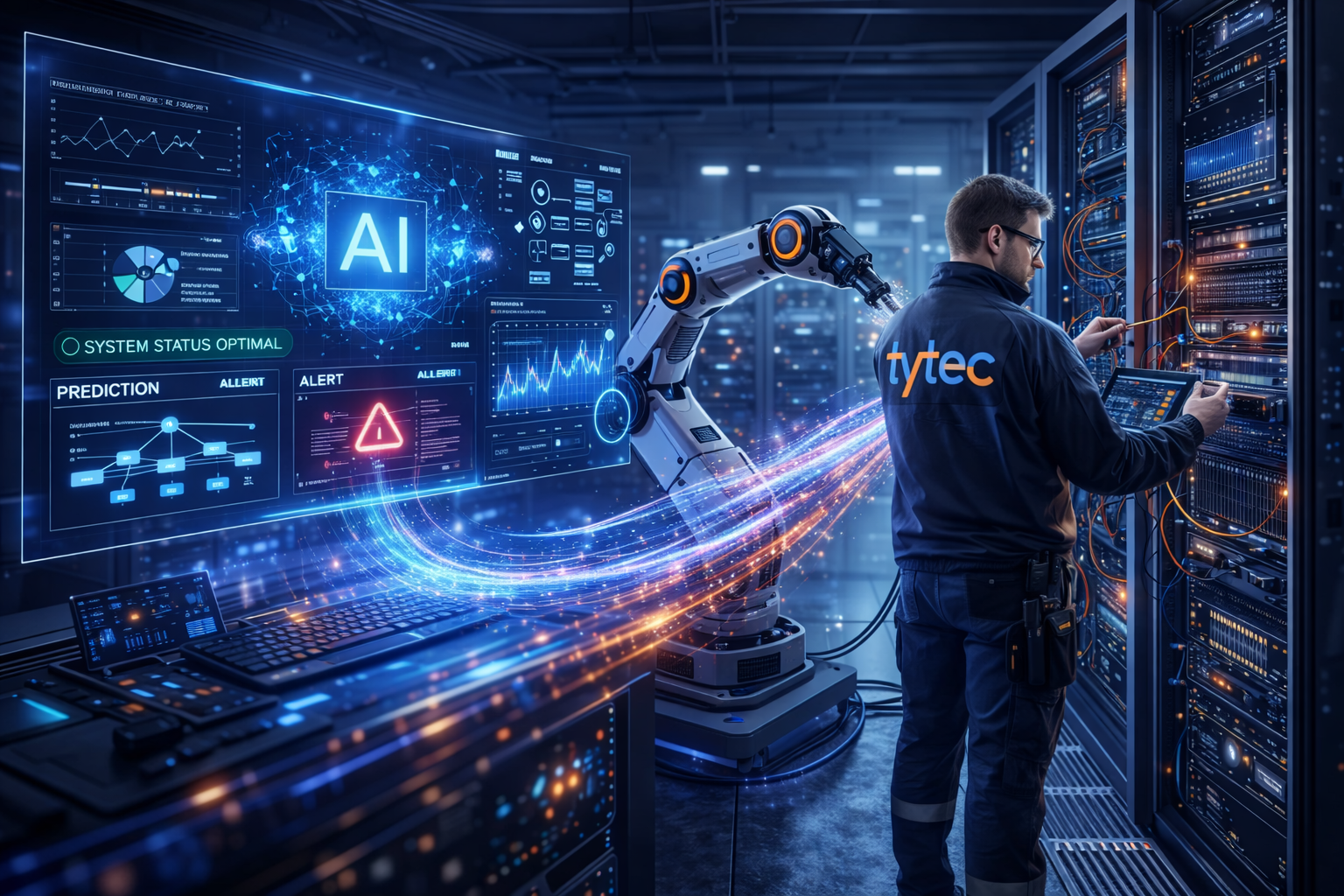
AI Can Decide, But It Still Can’t Act
Artificial intelligence has made enormous progress in recent years. Modern systems can monitor infrastructure, detect anomalies, predict failures, and even recommend actions with a level of speed and accuracy that would have been unthinkable just a few years ago. In many environments, AI is already deeply integrated into operations, continuously analyzing systems and providing insights in real time.
However, a fundamental limitation still exists.
AI can decide what needs to happen, but it can’t do it.
It can’t walk into a data center, replace a faulty component, reseat a cable, or physically inspect a rack. It can’t respond to access-controlled environments, handle hardware, or interact with the physical world in any meaningful way. No matter how advanced the system becomes, execution still requires a human presence.
This creates a growing gap between digital intelligence and physical action.
The Emerging Problem: AI Without Execution
As more organizations adopt AI-driven monitoring and automation tools, a new operational challenge is starting to emerge. Systems are becoming better at identifying issues earlier, prioritizing tasks, and even determining the steps required to resolve a problem. However, once that decision, the process often slows.
Systems create a ticket. An email is sent. A request is logged. Someone needs to interpret the information, coordinate access, and arrange for an engineer to attend the site. Even in well-organized environments, this introduces friction, delays, and opportunities for miscommunication.
In high-performance environments, particularly those supporting AI workloads, this delay can be costly. Infrastructure is running closer to its limits, and small issues can escalate quickly. The longer it takes to move from detection to execution, the higher the risk of downtime or degraded performance.
The lack of intelligence isn’t the issue.
A direct path to action is what is missing.
Introducing Tytec.ai
tytec.ai exists to solve exactly this problem.
Rather than acting as another monitoring or analytics platform, Tytec.ai functions as a bridge between AI systems and real-world execution. It allows AI services, automation platforms, and intelligent agents to directly initiate physical work through TYTEC, removing the traditional layers of manual coordination.
At a practical level, this means that when an AI system detects an issue or determines that a task needs to be performed, it can trigger that action directly. Instead of generating a ticket for a human to interpret, it can initiate a structured request that results in a qualified engineer deploying to carry out the work.
This isn’t about replacing human engineers. It’s about letting them be deployed faster, more efficiently, and with clearer intent.
From Insight to Action
The key advantage of tytec.ai is that it removes the friction between decision and execution.
In traditional workflows, multiple steps exist between identifying a problem and resolving it. People must transfer information between systems, interpret it, and translate it into actionable tasks. Each step introduces delay and increases the risk of errors or misalignment.
tytec.ai simplifies this process by acting as a structured intake and dispatch layer. tytec.ai defines requests clearly from the beginning, including what needs to happen, where it needs to happen, and the expected outcome. This ensures that when a task is initiated, it aligns with execution requirements.
The result is a much faster and more reliable transition from insight to action.
For organizations operating at scale, this isn’t just a convenience. It’s a significant operational advantage.
Designed for AI Agents and Automation Platforms
One of the most important aspects of tytec.ai is that designers built it with AI systems in mind from the beginning. It isn’t an afterthought or an add-on to an ongoing process. Designers built it specifically to allow AI-driven services to interact directly with physical infrastructure operations.
This means that AI agents can effectively “book” work in the same way a human would, but without the delays associated with manual coordination. The request is structured, validated, and routed automatically, ensuring that it can be executed without unnecessary back-and-forth.
As AI systems become more capable, this integration becomes increasingly important. The value of AI isn’t just in its ability to analyze data, but in its ability to drive outcomes. Without a clear path to execution, that value is limited.
tytec.ai unlocks that next step.
Real-World Execution at Scale
TYTEC has built its reputation on delivering reliable, on-site infrastructure services across Sweden and the wider Nordic region. This includes remote hands, break-fix support, installations, and site-specific engineering tasks carried out in controlled and often complex environments.
tytec.ai builds on this foundation by providing a scalable interface between digital systems and physical execution. It ensures that AI-generated requests can translate into real-world actions without losing context or clarity.
This is particularly important in distributed environments, where multiple locations require coordinated support for the infrastructure. By centralizing the intake and structuring of tasks, tytec.ai enables consistent execution regardless of where the work is taking place.
Why This Matters Now
The timing of this shift is critical.
AI is already transforming how infrastructure is monitored and managed. Systems are becoming more autonomous in their ability to detect issues and recommend solutions. However, without a corresponding evolution in how execution is handled, these advancements pose a risk that organizations won’t fully realize their benefits.
The gap between decision and action becomes more pronounced as systems become more intelligent. The better the AI becomes, the more obvious the limitations of manual coordination processes become.
tytec.ai addresses this directly by aligning execution capabilities with the speed and precision of AI-driven decision-making.
A New Operational Model
What tytec.ai represents isn’t just a new tool, but a new way of thinking about infrastructure operations.
In this model, AI systems are responsible for detection, analysis, and decision-making, while human engineers focus on execution. The two are connected through a structured interface that ensures clarity, speed, and reliability.
This creates a more efficient division of responsibilities. AI handles what it does best, processing information and identifying patterns, while humans handle what they do best, interacting with the physical world and performing complex tasks.
By connecting these two capabilities directly, tytec.ai enables a more streamlined and effective operational model.
Closing the Gap Between Digital and Physical
At its core, Tytec.ai is about closing a gap that has existed for as long as digital systems have managed physical infrastructure. That gap has always required human intervention to bridge it, often in inefficient and fragmented ways.
As AI becomes more central to operations, that gap becomes more significant.
tytec.ai provides a direct bridge, allowing digital systems to initiate real-world actions in a structured and reliable way. It ensures that insight doesn’t remain abstract, but is translated into tangible outcomes.
Conclusion: From AI Insight to Real-World Action
The evolution of infrastructure operations is about more than better monitoring or faster response times. It’s about aligning digital intelligence with physical execution in a way that removes friction and improves outcomes.
tytec.ai represents a step in that direction.
It allows AI systems to move beyond observation and into action, connecting their capabilities directly with the engineers who can carry out the work. In doing so, it transforms how we manage infrastructure, making it more responsive, more efficient, and better suited to the demands of modern environments.
AI can already tell you what needs to happen.
tytec.ai ensures that it happens.