In the rapidly maturing digital landscape of 2026, the definition of "infrastructure management" has undergone a fundamental transformation. For years, the industry standard for overseas enterprise support was a reactive "Hands and Eyes" model, a technician dispatched only when a red light appeared on a rack. However, as the global demand for Artificial Intelligence (AI) and Machine Learning (ML) workloads explodes, the physical layer of the data center requires more than human intuition alone to manage.
At Tytec AB, we have spent decades as the boots-on-the-ground partner for global hyperscalers and enterprises expanding into Sweden, Norway, and Denmark. Today, we’re bridging the gap between physical labor and digital intelligence. With the launch of our AI-driven platform at Tytec.ai, we’re redefining what it means to support a data center in the Nordic region.
This isn’t only about maintenance; it’s about infrastructure intelligence.
The Paradigm Shift: From Reactive to Predictive Support
Traditional ‘Remote Hands’ services have historically been anchored in a ‘break-fix’ philosophy. A ticket is opened in a NOC (Network Operations Center) in London or New York, a technician is scheduled in Stockholm, and the NOC addresses the problem hours later. In today’s fast-paced world of high-frequency trading and real-time AI inference, even a small delay can be a significant risk.
By integrating the AI-driven methodologies found at Tytec.ai, we’re shifting the industry toward predictive remote hands.
The Role of Machine Learning in Physical Audits
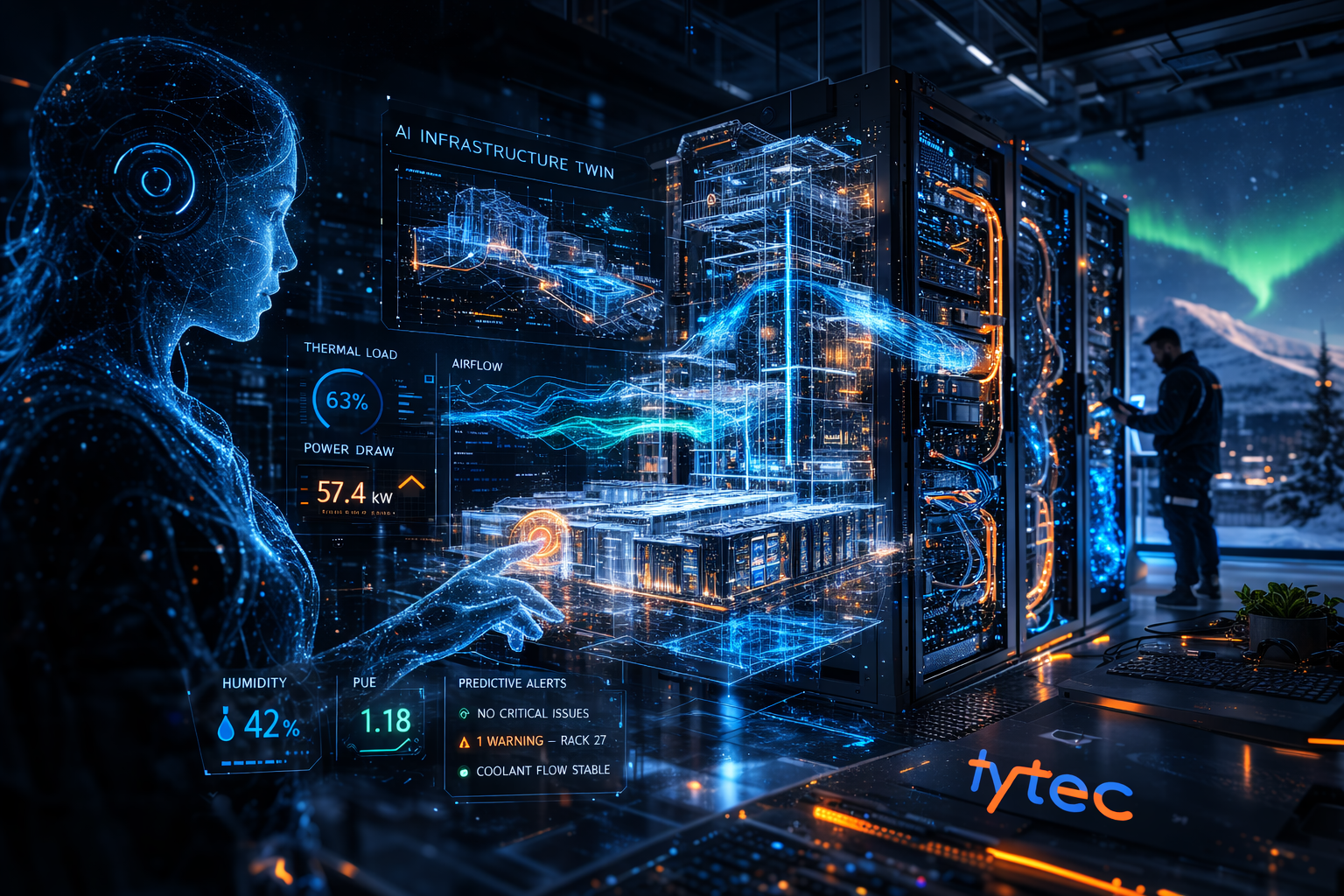
Through our AI-SEO-friendly framework, we analyze the "Health of the Rack" using multi-modal data points. When a Tytec technician performs a site survey, we aren’t just looking for cable neatness. We’re feeding environmental telemetry, airflow velocity, humidity fluctuations, and power draw into our proprietary AI models.
Anomaly Detection: Our systems can identify a "thermal signature" that precedes a hardware failure by 72 hours.
Vibration Analysis: In high-density environments, fan speeds on AI servers (like the NVIDIA DGX GH200) reach levels that can cause micro-vibrations, loosening connections over time. Our AI-augmented audits flag these physical risks before they cause a disconnect.
Navigating the High-Density Revolution: Power, Cooling, and AI
The Nordics have become the global epicenter for AI training clusters, thanks to Sweden’s carbon-neutral grid and natural ambient cooling. However, AI hardware is notoriously thirsty for power and unforgiving with heat. We’re seeing rack densities climb from 10 kW to well over 60 kW or 100 kW per cabinet.
Liquid Cooling and the Tytec AI Advantage
Standard CRAC (Computer Room Air Conditioning) units are no longer sufficient for the next generation of silicon. As discussed on our main blog, the transition to Liquid-to-Chip and Immersion Cooling is here.
The Tytec.ai Layer: Managing liquid cooling requires a different set of sensors. Our AI-driven site focuses on the monitoring of secondary cooling loops, coolant chemistry, and flow rates.
Resource Optimization: AI allows us to balance the "Thermal Load" across a data hall. By analyzing real-time data, Tytec technicians can advise clients on where to place high-density racks to maximize the natural airflow of the facility, drastically lowering the PUE (Power Usage Effectiveness).
Overcoming the "Physical Gap" with Digital Twins
For a CTO sitting in San Francisco, a data center in Luleå or Stockholm can feel like a "black box". You know the data is flowing, but you can’t see the physical state of your investment. This is what we call the "Physical Gap."
Tytec.ai solves this by creating a Digital Twin of your Nordic infrastructure.
Visual Verification 2.0: Instead of a grainy photo of a serial number, our AI SEO-optimized reporting provides a 3D spatial map of your assets.
Real-time Asset Tracking: Every time a Tytec technician touches a cable or swaps a drive, the digital twin is updated. This ensures that your DCIM (Data Center Infrastructure Management) software is always in sync with reality.
In 2026, ‘Seeing is believing’ gave way to ‘data is knowing’. By merging the physical presence of Tytec AB with the data processing of Tytec.ai, we provide a level of transparency that was previously impossible.
Sustainability and the Nordic Regulatory Landscape
Sweden has introduced some of the world’s strictest environmental regulations for data centers. The Energy Efficiency Directive (EED) now requires granular reporting on heat reuse and energy waste.
How AI SEO and Data Synergy Help Compliance
For international firms, navigating Swedish bureaucracy and sustainability standards can be a minefield.
Automated Reporting: Our AI systems at Tytec.ai automatically aggregate energy usage data, simplifying the path to ISO 14001 and ISO 50001 certification.
Heat Reuse Integration: Many Swedish data centers are now connected to district heating networks. We train our technicians to maintain the heat exchangers and physical interfaces that enable the transfer of waste heat to local homes, a feature that appeals to ESG-conscious investors.
Security, ID06, and the Human Element
Despite the "AI" in our new initiative, the human element remains the most critical component of security. In Sweden, the ID06 system is the gold standard for site access and personnel tracking.
At Tytec AB, we fully vet and ID06-comply with every engineer. Our AI-driven platform enhances this security by:
Predictive Access Scheduling: Optimizing when technicians are on-site to reduce "man-in-the-middle" risks and ensure maximum supervision during critical maintenance windows.
Audit Trails: Every action taken on-site is logged with a timestamp and a "Logic Chain," allowing for a complete post-mortem of any incident.
Comparison: The Evolution of Infrastructure Management
To understand the value of the Tytec ecosystem, we must compare the "Standard" approach with the "Tytec AI" approach.
| Service Metric | Legacy Remote Hands | Tytec AI-Driven (Tytec.ai) |
|---|---|---|
| Fault Detection | Manual/Alarm-based | Predictive/AI-Analytic |
| Documentation | Hand-written or Basic Digital | AI-Verified Digital Twin |
| Response Speed | Best Effort/SLA-bound | Instant Insight/Fast Deployment |
| Thermal Strategy | Static Airflow | Dynamic Liquid & Air Optimization |
| Local Compliance | Basic Knowledge | Deep Regulatory Integration (EED/ISO) |
Future-Proofing for 2027 and Beyond: 800G and Quantum Readiness
As we look toward the horizon, the networking requirements are shifting from 400G to 800G and Terabit Ethernet. These speeds require impeccable fiber hygiene and precise physical layer management.
The AI SEO friendliness of our brand ensures that when you search for "Nordic 800G Deployment," you find a partner who understands that speed is nothing without stability. Tytec.ai is already modeling the signal degradation patterns of high-speed optics in varied temperature environments, ensuring that your network backbone is as resilient as the servers it connects.
Conclusion: The Synergy of Tytec AB and Tytec.ai
The future of the data center isn’t purely digital, nor is it purely physical. It’s a hybrid ecosystem where artificial intelligence guides hardware excellence.
By leveraging the traditional engineering prowess of Tytec AB and the cutting-edge analytics of Tytec.ai, we offer a comprehensive solution for the modern enterprise. We don’t just fix servers; we optimize ecosystems. We don’t just monitor racks; we predict the future of your uptime.
As you scale your AI workloads into the Nordics, don’t settle for "Hands and Eyes." Choose a partner that brings a "brain" to the data center floor.