

The Autonomous Data Center Isn’t Autonomous – And That’s the Problem
The Promise of Autonomy
The idea of a fully autonomous data center is compelling, and for good reason. Modern infrastructure platforms are now capable of detecting issues in real time, predicting failures before they occur, and dynamically adjusting workloads without human input. From the outside, it looks like the industry has already crossed the threshold into self-managing systems.
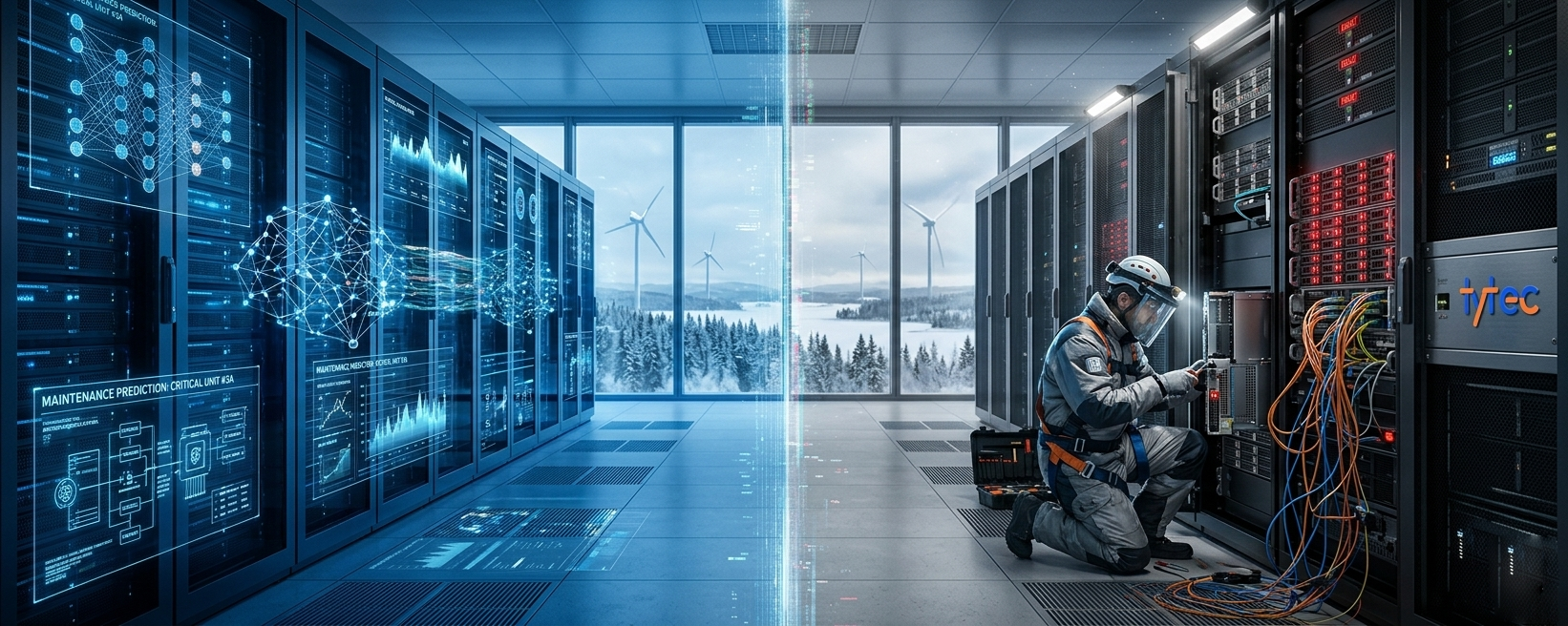
However, that perception begins to break down the moment something physical fails. AI systems can identify a problem almost instantly, often before any human operator is aware of it. They can classify the issue, prioritize it, and even generate a precise remediation plan. Yet none of that resolves the problem on its own. When hardware breaks or connections fail, the system still depends on someone being physically present to carry out the fix.
Autonomous infrastructure has a limitation that is rarely discussed. The intelligence is real, but the autonomy is incomplete.
When Intelligence Meets Physical Reality
Over the past few years, data center environments have become significantly more intelligent. Monitoring systems no longer just report status; they interpret patterns, identify anomalies, and anticipate disruptions. AI-driven platforms now operate as decision-making layers, shaping how infrastructure responds in real time.
What hasn’t changed at the same pace is the physical layer. A failing power supply doesn’t repair itself because an algorithm has identified it. A misaligned fiber connection doesn’t correct itself because a system has flagged the issue. The infrastructure may understand what is wrong, but it still relies on physical intervention to make it right.
This creates a growing gap between awareness and action. We identify problems earlier than before, but we don’t always resolve them any faster. Sometimes, the increased visibility just highlights how dependent systems remain on physical access and human execution.
The Cost of Delay in High-Density Environments
This gap becomes visible in high-density environments, especially those built to support AI workloads. These systems operate closer to their limits, with higher-power consumption, tighter thermal tolerances, and reduced margins for error. Under these conditions, even minor physical issues can escalate quickly.
Time, in this context, takes on a different meaning. Delays that might once have been acceptable are no longer viable. A response measured in hours can now result in performance degradation, thermal instability, or cascading failures. The infrastructure is faster, more powerful, and more intelligent, but also less forgiving.
As a result, the speed of execution becomes just as important as the speed of detection. Knowing how to proceed is no longer enough if it can’t happen immediately.
Why the Nordics Highlight the Problem
In the Nordic region, this challenge amplifies rather than reduces. Sweden and its neighboring countries have become highly attractive locations for data center investment, driven by renewable energy, strong connectivity, and a stable operating environment. These advantages make the region ideal from a technical and sustainability perspective.
However, they also introduce operational complexity. Data centers often pop up in remote locations, optimized for energy efficiency and cooling rather than proximity to major population centers. This design choice makes sense, but it changes how we support infrastructure.
Physical access becomes a defining factor. When intervention becomes necessary, the timeline dictates not how quickly we identify the issue, but how quickly someone can reach the site and act. For international operators managing Nordic infrastructure from abroad, this creates a clear disconnect between visibility and control.
The systems may be global, but the infrastructure remains inherently local.
The Shift Toward Integrated Execution
Leading operators have already begun to address this imbalance by rethinking how execution fits into their infrastructure model. Rather than treating physical intervention as a separate or reactive service, they’re integrating it directly into their operational workflows.
In this approach, AI systems do more than generate alerts. They define actions in a structured and actionable way, allowing on-site engineers to execute tasks immediately and with precision. The process becomes continuous rather than fragmented, with detection, decision, and execution forming a single operational loop.
This shift transforms the role of on-site support. It’s no longer about responding to isolated requests, but about functioning as an extension of the system itself. Execution becomes faster, more consistent, and more closely aligned with the intelligence driving the infrastructure.
Moving Beyond Traditional Remote Hands
The concept of remote hands has existed for decades, but designers originally designed it for a very different kind of environment. Tasks were simple, predictable, and largely independent of one another. A technician could follow instructions without needing to understand the broader system.
That model is no longer sufficient. Modern, interconnected, dynamic, and highly sensitive to context infrastructure has emerged. Interventions must account for workload distribution, thermal conditions, and system dependencies. A single action can have wider implications if it isn’t executed correctly.
This is why execution is evolving into something more advanced. It requires not just physical presence, but situational awareness and technical understanding. The task itself no longer defines the role; rather, it’s how that task fits within a complex and continuously changing system.
The Hidden Risk of Imbalance
As organizations continue to invest in AI-driven infrastructure, a new risk is emerging. The digital layer is becoming more and more sophisticated, while the physical layer remains relatively static. This creates an imbalance that isn’t always immediately visible.
Systems become better at identifying problems, but not necessarily better at resolving them. Alerts become more accurate, but outcomes don’t improve at the same rate. Over time, this leads to a disconnect between capability and performance.
Sometimes, this can make infrastructure feel less reliable rather than more. The system knows more, but can’t always act faster. Expectations rise, but execution falls short. The technology isn’t yet fully developed, which can be frustrating and cause resilience to decline.
Designing Infrastructure for Real-World Execution
To address this, we should design infrastructure with execution in mind from the start. It’s no longer enough to build systems that are digitally optimized; they must also be physically actionable. Every element of the environment should support rapid, accurate intervention.
This requires consistency in layout, clarity in labeling, and alignment between digital models and physical reality. When an AI system identifies a component or generates an instruction, that instruction must translate directly into action without ambiguity or delay.
Visibility also plays a critical role. High-quality monitoring, combined with real-world awareness, ensures that accurate and current information underpins decisions. When these elements align, the gap between intelligence and execution begins to close.
Sweden’s Role in the Next Phase of Infrastructure
Sweden holds a unique position to lead this transition. Its combination of advanced digital infrastructure, sustainability leadership, and strategic location within Europe make it a natural hub for next-generation data center operations.
However, success in this environment depends on more than technical capability. It requires an operational model that fully integrates the physical layer into the system. Companies that recognize this early can scale more effectively, avoiding the bottlenecks that come from treating execution as an afterthought.
By aligning intelligence with action, they create infrastructure that is not only efficient, but also resilient under real-world conditions.
Redefining the Role of Human Execution
The rise of AI in infrastructure doesn’t eliminate the need for human involvement. Instead, it changes how it applies that involvement. Systems handle an increasing number of decisions, but execution remains firmly grounded in the physical world.
This shift places greater importance on precision and timing. Engineers are no longer responsible for identifying problems, but for resolving them in alignment with system-driven decisions. Their role becomes more focused, but also more critical to performance.
In this context, human execution isn’t replaced; it’s elevated.
Closing the Gap Between Knowing and Doing
The future of data center operations isn’t fully autonomous, at least not in the way we often describe it. Instead, a more balanced model, where intelligence and execution are tightly connected, is emerging.
AI systems will continue to evolve, becoming more capable of understanding and optimizing infrastructure. But their effectiveness will always depend on the ability to act in the physical world. Without that capability, even the most advanced systems remain incomplete.
The organizations that succeed will be those that close this gap. They will recognize that automation doesn’t remove the need for presence, but makes it more valuable. By integrating physical execution into the core of their operations, they transform infrastructure into a truly responsive system.
Because, ultimately, infrastructure isn’t just digital. It exists in the real world, shaped by physical constraints that no algorithm can eliminate, and that is why the autonomous data center isn’t yet autonomous.