

The Next Customer Isn’t Human: Preparing TYTEC for Autonomous AI Procurement and AI-Driven Service Ordering
The Rise of AI as a Customer in Infrastructure and Service Procurement
For years, we have framed artificial intelligence as a tool designed to support human decision-making, sitting quietly in the background to optimize processes, analyze data, and improve efficiency. That framing is now becoming outdated. A more profound shift is taking place, one that moves AI out of the role of assistant and into the role of actor. Increasingly, AI systems aren’t just recommending actions, but initiating them, executing them, and closing the loop independently. In this emerging model, AI is no longer just enabling customers. It’s becoming the customer.
This transition is most visible in infrastructure environments, where systems are already deeply instrumented and continuously monitored. In these settings, AI systems are capable of detecting anomalies in real time, diagnosing causes with high accuracy, and determining appropriate responses based on predefined operational rules. The final step, execution, has traditionally required human involvement, but that requirement is rapidly disappearing. Once an AI system can initiate a service request directly, the entire workflow changes. The moment an AI can detect a problem and order its resolution without human intervention, it crosses the threshold into autonomous procurement.
From Human-Initiated Workflows to Autonomous AI Service Ordering
Human initiation builds around traditional service workflows. Even in highly optimized environments, a chain of actions must occur before work is executed. A system raises an alert, a human reviews the issue, the team creates a ticket, contacts a vendor, and agrees on a scope of work before execution begins. Each step introduces delay, interpretation, and variability. While people have refined these processes over time, they remain inherently dependent on human coordination.
Autonomous AI service ordering removes these constraints entirely. When an AI system detects a failure condition, such as a degraded network link, a failing component, or an environmental anomaly, it doesn’t describe the issue in abstract terms. Instead, it generates a structured, machine-readable work order that defines the problem, specifies the required action, and outlines the expected outcome with no ambiguity or delays. The instruction is precise, actionable, and complete.
This represents a fundamental shift in how service providers interact with demand. A human customer communicates through conversation, context, and clarification. An AI customer communicates through definition, instruction, and verification. It doesn’t browse websites, evaluates brand messaging, or engage in discussion. It determines whether a service can be accessed through code and executed reliably. If it can’t, that service is effectively invisible.
Why Traditional Service Delivery Models Aren’t Compatible With AI Procurement
Service organizations today have not been designed to operate in this environment. They describe their offerings in flexible, human-readable terms; their pricing structures often rely on negotiation; and their intake processes depend on manual communication channels such as email or web forms. These models work well when humans are involved, but they break down completely when the initiating entity is an AI system.
AI-driven procurement requires a different approach. We must explicitly define services with explicit inputs, outputs, and conditions. Pricing must be predictable and rule-based, allowing an AI to evaluate cost without ambiguity. Ordering must be possible through APIs or other structured interfaces, enabling direct system-to-system interaction. Most importantly, execution must be verifiable through objective evidence, not subjective confirmation. An AI system can’t interpret statements like “issue resolved”. It requires measurable proof that the defined outcome has been achieved.
This creates a new standard for service providers. It’s no longer enough to offer high-quality execution. Designers must create services in a way that allows machines to consume them.
Understanding AI-to-Service Procurement and Automated Infrastructure Execution
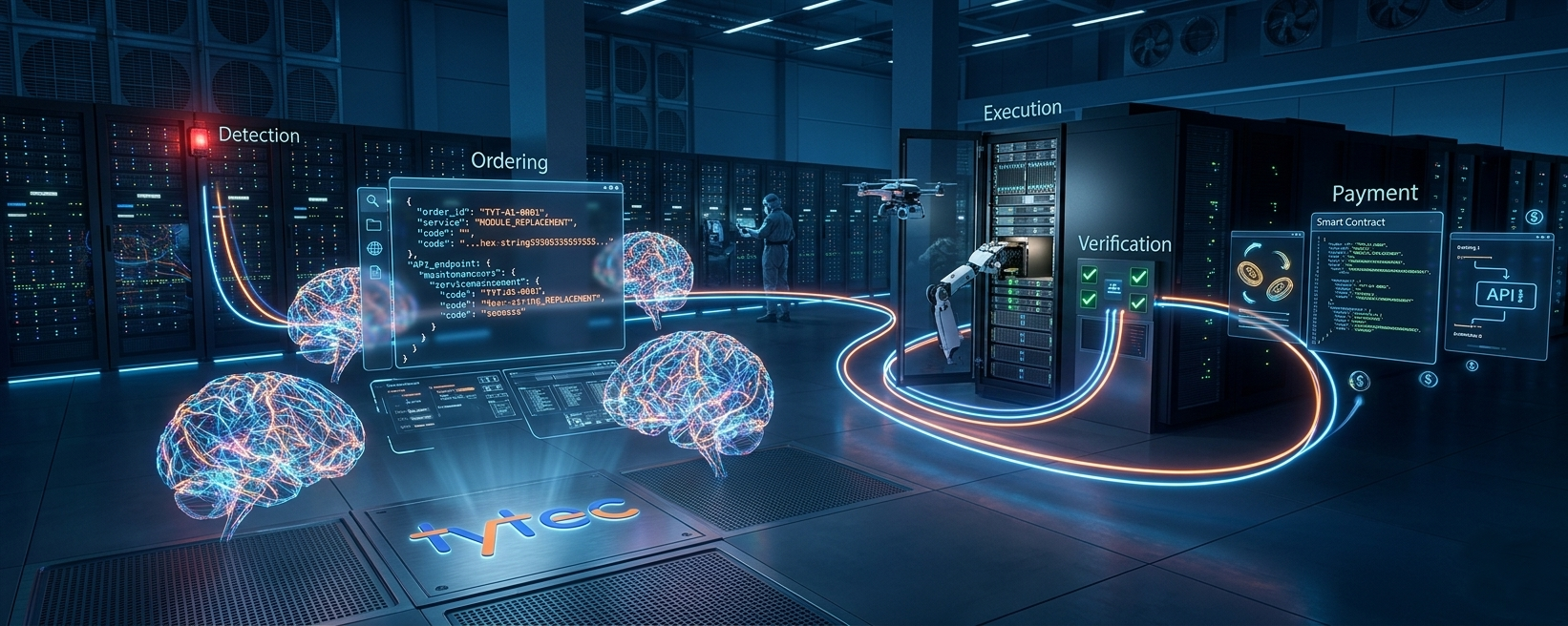
AI-to-service procurement represents the natural evolution of automation in infrastructure and operations. In this model, AI systems don’t just identify issues; they resolve them end to end by interacting directly with service providers. The workflow becomes continuous and self-contained. An issue is detected, evaluated against predefined thresholds, and if it meets the criteria for automated action, the model selects a service provider. A structured work order generates and transmits, the task executes, and the task returns evidence of completion. The AI system then validates the outcome and proceeds to close the loop.
This process isn’t theoretical. Elements of it already exist in controlled environments, particularly in data centers, telecommunications networks, and distributed infrastructure systems where advanced monitoring and well-defined execution tasks exist. As these systems mature, the scope of autonomous procurement will expand, encompassing more complex tasks and higher-value decisions.
Autonomous Payments and AI-Driven Financial Transactions for Services
While automated service ordering is a critical component of this shift, it’s only part of the equation. For AI-to-service procurement to function fully, automated payment is essential. This introduces a set of requirements that extend beyond operational workflows into financial systems.
An AI system must operate with a defined identity, allowing it to act on behalf of an organization or operational domain. Authorization rules that determine what it can approve, under what conditions, and within what financial limits must govern it. Finally, it must have access to settlement mechanisms that enable transactions to occur automatically once workers have completed and verified it. These mechanisms may include API-based billing systems, pre-funded execution accounts, or programmable payment infrastructures.
When these elements are in place, the procurement loop becomes fully autonomous. Detection, ordering, execution, verification, and payment all occur within a closed system, requiring no human intervention under normal conditions. This represents a significant step toward fully autonomous infrastructure operations.
How TYTEC Is Building Infrastructure Services for AI Customers
TYTEC occupies a unique position to operate within this emerging model because our approach to service delivery already embodies many of the required characteristics. Our focus on structured execution, defined tasks, and evidence-based outcomes aligns directly with the needs of AI-driven systems. Rather than adopting a human-centric model, we’re extending a framework that is inherently compatible with machine-driven demand.
The next phase of development involves making these capabilities explicitly accessible to AI systems. This includes defining services in machine-readable formats that machines can interpret without ambiguity, enabling API-based service ordering to allow direct integration with AI platforms, and implementing deterministic pricing models that support automated decision-making. It also involves standardizing evidence outputs so that completion can be verified programmatically, and preparing billing systems for integration with autonomous payment mechanisms.
These developments aren’t about changing what TYTEC does, but about evolving how our services are accessed and consumed. The physical execution layer remains the same. The interface becomes machine-compatible.
The Future of AI-Driven Service Procurement and Vendor Selection
As AI systems take on a more active role in procurement, the criteria used to select service providers will change fundamentally. Traditional factors such as brand recognition, marketing presence, and long-standing relationships will become less influential. Instead, attributes that align with machine decision-making will drive selection.
Clarity of service definition will determine whether people can understand a service. Reliability of execution will determine whether people can trust it. Verifiability of outcomes will determine whether we can validate it. Ease of integration will determine whether it can be accessed. These factors will form the basis of competition in an AI-driven marketplace.
This shift doesn’t eliminate human decision-making, but it introduces a parallel system that operates at a different speed and scale. Companies that are prepared to operate within this system will benefit from continuous, automated demand. Those who don’t do so may find themselves excluded from a growing market segment.
Preparing for Autonomous AI Customers in Infrastructure Services
The transition to AI-driven procurement will be gradual, but it’s already underway. It will begin in environments where automation’s benefits are highest and implementation is most feasible. Over time, it will expand into broader domains as systems become more capable and trust in autonomous processes increases.
For service providers, preparation begins with clarity. Providers must define services precisely, standardize execution processes, and structure outputs in a way that supports verification. From there, integration becomes possible, enabling direct interaction between AI systems and service providers.
At TYTEC, the focus is on building a service layer that supports both human and AI customers seamlessly. This means recognizing that the definition of a customer is evolving and that future demand will come not only from people, but from the systems they deploy.
Conclusion: The Emergence of AI as a Direct Customer of Infrastructure Services
The shift toward autonomous AI procurement represents a new phase in the evolution of infrastructure and service delivery. It doesn’t replace human customers, but it introduces a form of demand that operates continuously, precisely, and at scale. AI systems won’t ask questions, negotiate terms, or interpret ambiguity. They will evaluate, decide, and act based on defined parameters.
When that shift reaches critical mass, the distinction between tool and customer will no longer matter. Whether a machine can access, understand, and execute a service will matter.
The next customer won’t be human, and when it arrives, it will only interact with systems that are ready.