

The AI-Ready Rack: Preparing Nordic Data Centers for the Liquid Cooling Revolution
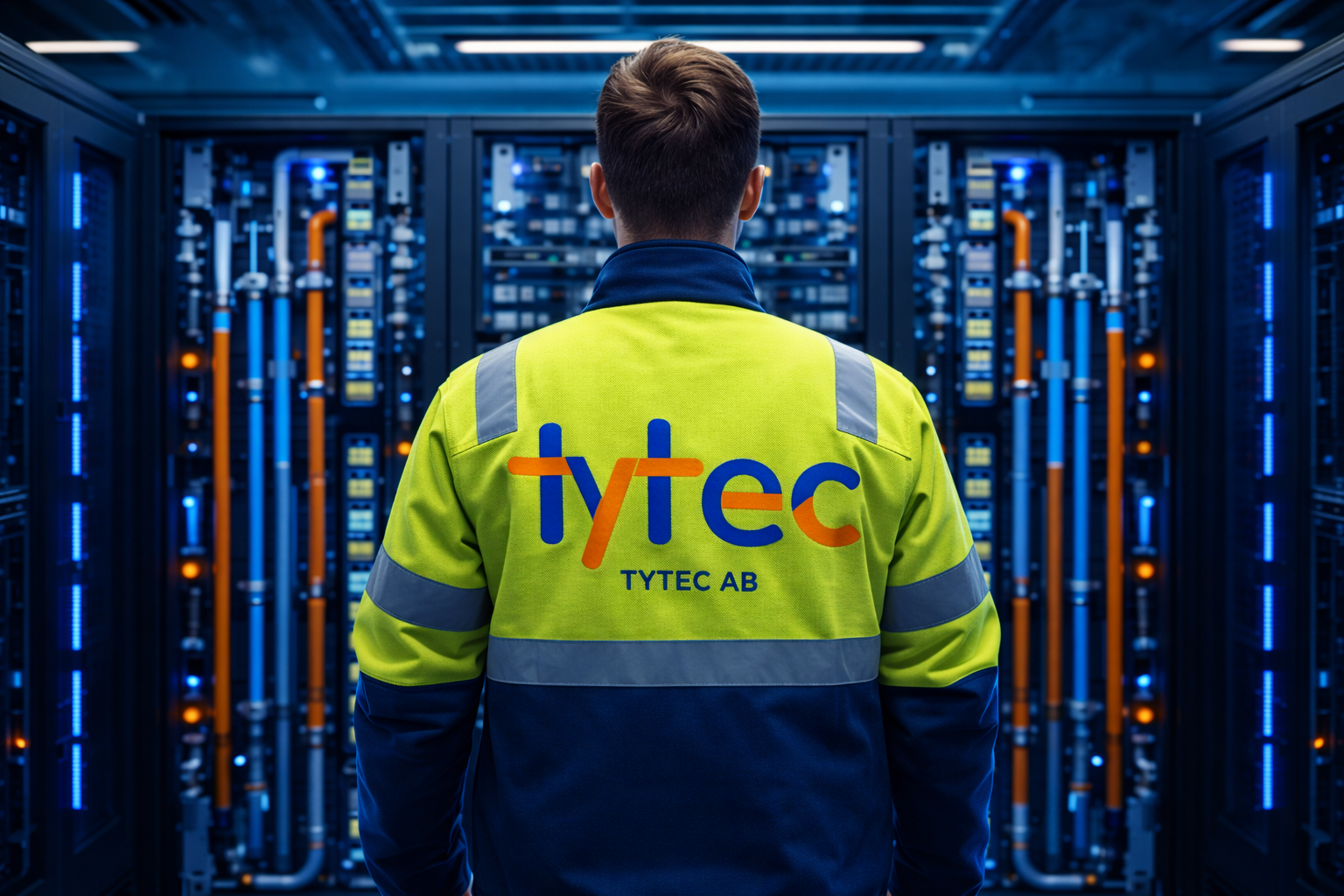
As we move deeper into 2026, the global data center landscape is facing a pivotal "thermal ceiling". The explosion of Artificial Intelligence (AI), Large Language Models (LLMs), and High-Performance Computing (HPC) has fundamentally changed the physics of the data hall. In the Nordic region; long heralded as the world’s premier destination for sustainable compute, this shift is creating a massive opportunity for operators to evolve.
At TYTEC AB, we’re seeing a surge in demand for Smart Remote Hands and Eyes to support a new generation of hardware. The transition from traditional air cooling to advanced liquid cooling is no longer a "future" trend; it’s a current necessity for any facility aiming to stay competitive in the AI era.
The AI Challenge: Why Air Cooling Is Reaching Its Limit
For decades, the standard data center rack operated within a 5 kW to 15 kW power envelope. Standard CRAC (Computer Room Air Conditioning) units and hot/cold aisle containment were more than sufficient to manage these thermal loads. However, the hardware required for AI, specifically high-end GPUs from the likes of NVIDIA and AMD, has pushed rack densities into the 30 kW, 50 kW, and even 100kW+ range.
Air isn’t an efficient enough medium to transport that much heat away from high-density silicon. To prevent thermal throttling and hardware failure, the industry is turning to liquid. Because water (or specialized dielectric fluid) has a heat-carrying capacity over 3,000 times greater than air, it’s the only viable solution for the "AI-ready rack."
The Nordic Advantage: Why Liquid Cooling and the Nordics are a Perfect Match
Sweden, Norway, Denmark, and Finland have long been the go-to locations for "Green Data Centers" due to the cold climate and abundance of renewable energy. When you combine liquid cooling with the Nordic environment, you unlock three major strategic advantages:
Lower PUE (Power Usage Effectiveness): Liquid cooling systems can operate with higher facility water temperatures. This means Nordic operators can use "free cooling" for almost the entire year, drastically reducing the energy used for chillers.
Heat Reuse Integration: Liquid-to-liquid heat exchange produces higher-grade waste heat than air systems. In many Nordic municipalities, this heat can be directly injected into district heating networks, turning a data center from a consumer of energy into a community utility.
Physical Resilience: Liquid systems are closed loop and pressurized. In the harsh Nordic winter, these systems are more stable and less prone to the humidity fluctuations that can plague air-intake systems.
Key Liquid Cooling Technologies for 2026
If you’re planning a retrofit or a new build, you should consider three primary technologies. Each requires a different level of on-site technical expertise for installation and maintenance.
1. Direct-to-Chip (Cold Plate) Cooling
This is currently the most popular "bridge" technology. We mount a cold plate directly onto the CPU or GPU. Liquid is circulated through the plate to whisk heat away.
The Benefit: It can be integrated into current air-cooled facilities with relatively minor modifications.
The Challenge: It requires complex internal manifold routing and leak-detection sensors at the rack level.
2. Rear Door Heat Exchangers (RDHx)
An RDHx replaces the standard back door of a server rack with a large radiator. As hot air exits the servers, it passes through the liquid-filled door, which neutralizes the heat before it even enters the room.
The Benefit: It allows for "hot-aisle-less" data centers and can support densities up to 50 kW.
The Challenge: It adds significant weight to the rack and requires precision plumbing at the base of every cabinet.
3. Immersion Cooling (single phase and two phases)
This is the "gold standard" for AI density. Technicians submerge servers in a tank of non-conductive (dielectric) liquid. The fluid boils or circulates, removing heat from all the components, not just the processors.
The Benefit: Near-silent operation, zero fans (reducing "parasitic power"), and the ability to handle 100kW+ per tank.
The Challenge: Requires a total rethink of hardware maintenance and ‘Smart Hands’ with training to handle submerged components.
The Operational Reality: How to Prepare Your Infrastructure
Transitioning to an AI-ready facility isn’t about buying new racks; it’s about the physical layer and site-level engineering. Here is how Nordic IT teams should be preparing:
Step 1: Structural and Floor Load Audits
Liquid-cooled racks and immersion tanks are significantly heavier than air-cooled cabinets. Before deployment, a professional Site Survey is essential to ensure that raised floors or concrete slabs can handle the increased PSF (pounds per square foot).
Step 2: Plumbing and Manifold Management
Liquid cooling introduces a utility to the data hall: water. Managing the secondary fluid loop requires precision. This includes:
CDU (Coolant Distribution Unit) Placement: The "heart" of the system that regulates flow and temperature.
Leak Detection Systems: Installing and calibrating moisture-sensing cables at every connection point.
Filtration and Chemistry: Monitoring the fluid to prevent biological growth or corrosion.
Step 3: Redefining Remote Hands Support
Traditional IT support involves swapping a drive or a power supply. In a liquid-cooled environment, "Remote Hands" must now be "Technical Fluid Engineers." When a server in a cold-plate rack needs a component swap, the technician must handle dripless couplings, manage potential spills, and ensure correct re-pressurization of the loop.
Sustainability as a Business Driver
In 2026, ESG (Environmental, Social, and Governance) reporting is a mandatory requirement for most enterprise-level firms. Moving to liquid cooling in the Nordics isn’t just a technical upgrade; it’s a sustainability win. By lowering your PUE and participating in heat recovery programs, your data center becomes an asset to the local power grid rather than a drain.
Furthermore, liquid cooling extends the lifespan of expensive AI hardware. By maintaining a constant, lower temperature, you reduce the "thermal cycling" stress on GPUs, leading to fewer hardware failures and less e-waste.
Why TYTEC AB Is Your Partner for the AI Transition
Deploying AI infrastructure in Stockholm, Oslo, or Helsinki requires more than just a delivery truck. It requires a partner who understands the local nuances of Nordic data centers.
At TYTEC AB, we specialize in the Smart Remote Hands and Eyes necessary to maintain these complex systems. Our services include:
Comprehensive Site Surveys: Evaluating power, cooling, and structural readiness for AI clusters.
Thermal Audits: Using FLIR thermography to identify hotspots in transition zones where air and liquid cooling coexist.
Precision Testing: Ensuring optimal fiber connectivity (via EXFO testing) for the ultra-low latency required by AI clusters.
24/7 On-Call Support: Providing localized, expert technicians who can respond to infrastructure alerts in minutes, not hours.
Conclusion: Don’t Get Left in the Heat
The "AI-Ready Rack" is the new standard for the modern data center. For Nordic businesses and international firms operating in the region, the combination of renewable energy and liquid cooling provides a competitive edge that is impossible to ignore.
However, the complexity of these systems means that the "physical layer" can no longer be an afterthought. Reliability begins with a foundation of precise engineering and professional on-site support.
Are you ready to retrofit your facility for AI workloads? Contact TYTEC AB today to schedule a site survey and learn how our Smart Remote Hands can support your transition to the future of high-density compute.