

Adapting Nordic Data Centers for the AI Era: High-Density Cooling and Power Strategies
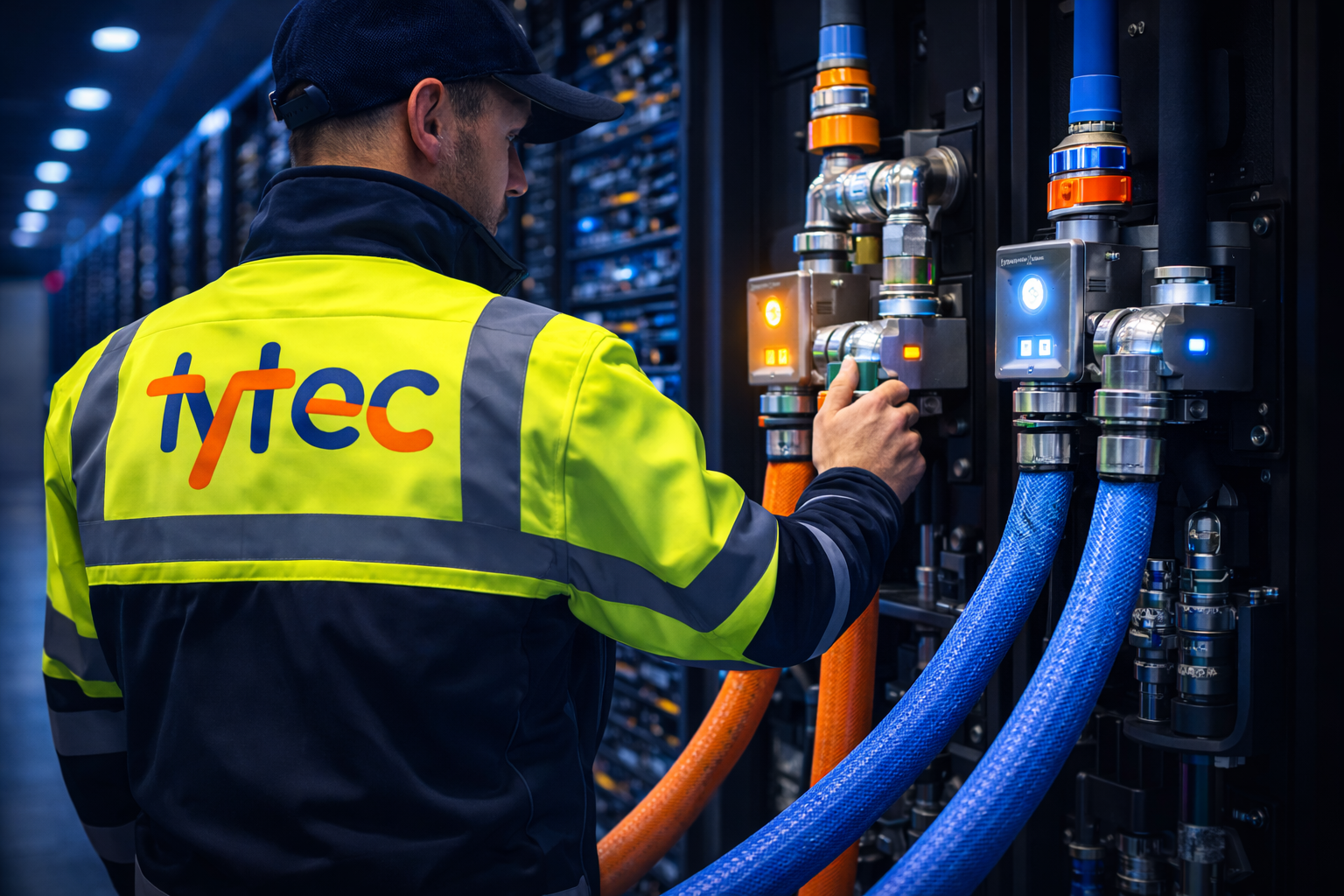
As AI and HPC workloads surge, Nordic data centers must evolve. Learn how to prepare your infrastructure for high-density computing, liquid cooling, and extreme power demands with Tytec AB’s expert insights.
The Nordic region has long been a sanctuary for data centers. With our naturally cool climate, abundance of renewable hydropower, and stable political environment, Sweden, Norway, Denmark, and Finland have become the engine room for much of Europe’s digital infrastructure. However, the rapid ascent of Artificial Intelligence (AI) and High-Performance Computing (HPC) is rewriting the rules of physical infrastructure. The "standard" data center setup that has served us well for the last decade is no longer sufficient for the GPU-dense clusters of tomorrow.
For IT decision-makers and facility managers in the Nordics, the question isn’t about sustainability anymore, but about survivability in the age of extreme density. In this post, we explore the physical reality of AI deployment and how Nordic facilities can retrofit and prepare their infrastructure to handle the heat, weight, and power of the next generation.
The Shift from Standard to Extreme Density
For years, the industry average power density hovered comfortably between 5 kW and 8 kW per rack. While hyperscalers pushed boundaries, most enterprises and colocation facilities operated well within these limits.
Enter the era of Generative AI and Large Language Models (LLMs). A single rack of modern NVIDIA or AMD GPU servers can easily demand 40 kW to over 100 kW. This isn’t a linear increase; it’s an exponential jump that breaks traditional cooling and power distribution models.
When you place a 50 kW rack in a room designed for 5 kW averages, you don’t just create a hotspot; you risk cascading failure. The ‘blast radius’ of heat generated by these racks can overwhelm standard CRAC (Computer Room Air Conditioning) units, leading to thermal throttling where expensive hardware slows to protect itself, destroying the ROI of your AI investment.
Beyond Air: The Necessity of Liquid Cooling Readiness
The most critical discussion "this week" in the data center world is the transition from air to liquid. While the Nordics benefit from free air cooling for much of the year, air has a physical limit. As chip thermal design power (TDP) pushes past 700 W and approaches 1,000 W per GPU, air isn’t an efficient transfer medium.
We’re seeing a bifurcated approach in the Nordic market:
Rear Door Heat Exchangers (RDHx): A "bridge" technology that brings liquid to the back of the rack to neutralize heat before it enters the room. This is often the easiest retrofit for existing Nordic facilities.
Direct-to-Chip (DTC) liquid cooling: Cold plates sit directly on the CPU/GPU components. This requires distinct plumbing (CDUs - Coolant Distribution Units) and a facility floor capable of handling potential leaks and fluid distribution.
Tytec AB’s engineering teams are increasingly called upon to perform site feasibility surveys for these retrofits. We check the underfloor limitations, the path for secondary cooling loops, and the physical space required for CDUs. If your facility is eyeing an AI deployment, you need to verify now if your raised floor can accommodate the piping and if your containment systems are compatible with hybrid cooling architectures.
The Heavyweight Champions: Structural Integrity
One often overlooked aspect of AI infrastructure is mass. High-density compute isn’t just hot; it’s incredibly heavy. A fully loaded rack of GPU servers, combined with liquid cooling manifolds, coolant fluid, and reinforced PDUs, can weigh significantly more than a standard server rack, sometimes exceeding 1,500 kg (3,300 lbs).
Builders designed many older Nordic facilities with raised floors rated for lighter telecom or standard IT loads. Placing a modern AI cluster on a floor not rated for such point loads poses a severe structural risk.
Tytec’s Recommendation: Before procurement, conduct a structural audit.
Floor Loading: Check the dynamic and static load ratings of your raised floor tiles and pedestals.
Transport Paths: Ensure that the path from the loading dock to the data hall (including elevators and ramps) can support the weight of pre-integrated racks.
Seismic/Vibration Bracing: While the Nordics are seismically stable, the vibration from high-velocity cooling fans and pumps in dense racks requires robust bracing to prevent connector fatigue over time.
Power Distribution: The Last Meter Matter
Delivering 100 kW to a single rack changes the "last meter" of power distribution. Standard 16A or 32A feeds are insufficient. We’re moving toward 63A three-phase feeds or busbar tap-off boxes as the standard for AI rows.
This shift requires a "Remote Hands" team that understands high-voltage safety and the intricacies of three-phase load balancing. An imbalanced three-phase feed at these wattages can cause significant harmonic distortion and breaker trips.
At Tytec, our technicians are seeing a surge in requests for PDU upgrades. Replacing intelligent PDUs (iPDUs) in a live environment is high-risk. It requires precise planning, temporary load migration, and a "smart hands" team that follows strict Method of Procedure (MOP) documents to ensure zero downtime.
The Nordic Advantage: Why We Win in the AI Era
Despite these physical challenges, the Nordic region is arguably the best place on Earth for AI infrastructure. Why?
Grid Stability: AI training runs can take weeks. A power flicker can cost millions in lost training time. The Nordic grid is among the most stable globally.
Heat Reuse: High-density racks produce high-grade heat (often 40 °C -60 °C water output from liquid cooling). In Sweden and Finland, this heat is a valuable commodity that planners can pump directly into district heating networks, turning a waste product into a revenue stream and a sustainability win.
Cost Efficiency: With AI compute consuming massive kWh, the lower industrial electricity rates in Northern Sweden and Norway provide a competitive edge (OPEX) that offsets the higher initial CAPEX of liquid cooling retrofits.
How Tytec Supports Your High-Density Journey
You must measure what you can manage, and you must understand what you want to upgrade. Tytec AB serves as the eyes and ears for international and local companies scaling up in the Nordics.
1. High-Density Site Surveys: Our engineers validate your facility’s readiness for AI. We document power availability, cooling headroom, airflow dynamics, and structural capacity before the hardware arrives.
2. Smart Remote Hands for Complex Installs: Deploying liquid-cooled racks isn’t a standard "rack and stack". It involves leak detection sensor installation, manifold coupling, and precise cable management to ensure that airflow doesn’t choke. Our teams have trained in these modern complexities.
3. Thermal Audits & Optimization: Using thermal imaging (as detailed in our Thermal Audit post), we identify if your current cooling is bleeding efficiency. Before you add high-density loads, we help you seal the room to maximize static pressure and cooling capacity.
Future-Proofing for the Intelligence Age
The "AI Boom" isn’t just a software revolution; it’s a hardware evolution. For Nordic data centers, this is the moment to audit, upgrade, and fortify. The facilities that prepare for liquid cooling and high-density power today will capture the workloads of the next decade.
Whether you’re retrofitting a colocation cage in Stockholm or building a new edge facility in northern Norway, the physical layer must be flawless. At Tytec AB, we provide the technical expertise and local presence to ensure your infrastructure is ready for the weight, heat, and power of the future.
Ready to assess your facility’s AI readiness? Contact Tytec AB today for a comprehensive site survey and infrastructure consultation.