

AI Data Centers Are Creating a New Infrastructure Crisis, and How TYTEC Solves It
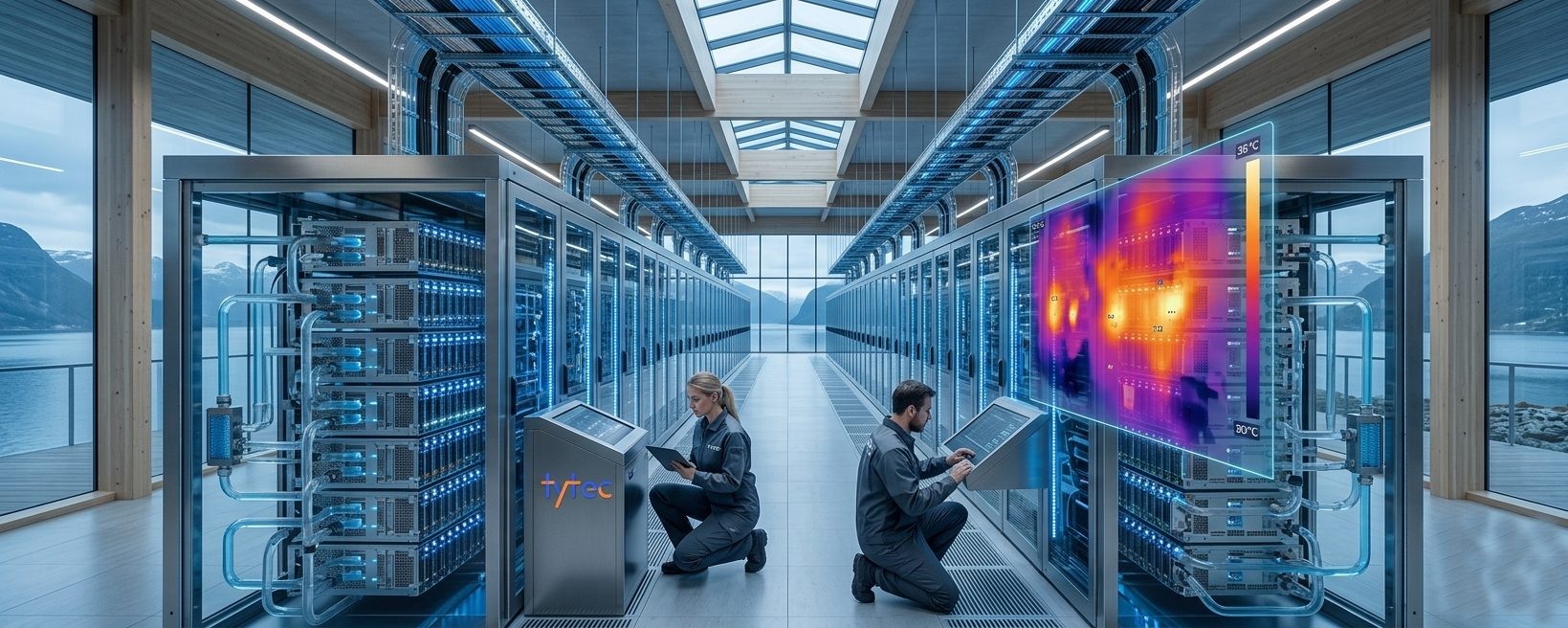
Artificial intelligence is reshaping the global technology landscape faster than almost any previous computing revolution. Across Europe and the Nordic region, operators are racing to deploy new AI infrastructure capable of supporting advanced machine learning, large language models, inference platforms, and next-generation data processing environments. Massive GPU clusters are becoming standard, network speeds continue climbing toward 800G and beyond, and demand for stable, scalable infrastructure is growing at an extraordinary pace.
But beneath the excitement surrounding AI lies a growing operational problem that many organizations are only beginning to understand. The industry has spent years discussing software, cloud platforms, and computational performance, yet it has paid far less attention to the physical infrastructure required to support these environments in the real world. As AI deployments continue accelerating, data centers are facing mounting pressure from increasing rack densities, rising thermal loads, more complex fiber environments, and infrastructure requirements that traditional operational models couldn’t handle.
This is no longer simply a matter of adding more servers to current facilities. AI is fundamentally changing the operational reality of modern infrastructure.
At TYTEC AB, we work with operators, enterprises, and hyperscale environments across Sweden and the Nordic region, supporting the physical infrastructure layer that keeps modern data centers operational. What we’re seeing across the industry is clear: AI infrastructure is evolving faster than many facilities can realistically adapt. The organizations that succeed over the next decade will be the ones capable of managing not only digital complexity, but the physical challenges that come with it.
AI Infrastructure Is Scaling Faster Than Traditional Data Centers Can Adapt
For many years, data center operations followed relatively predictable patterns. Traditional enterprise workloads operated within manageable thermal boundaries, cooling systems evolved gradually, and remote support models were often reactive rather than proactive. A hardware issue occurred, a ticket was opened, and technicians resolved the problem on-site. That operational approach worked because the infrastructure itself remained relatively stable and forgiving.
AI environments are very different.
Modern GPU clusters generate levels of heat and power consumption that dramatically exceed traditional server deployments. Rack densities that once averaged modest thermal output are now pushing beyond 60kW, with some advanced AI deployments approaching or exceeding 100kW per cabinet. This changes the entire operational equation inside the data center. Airflow patterns become more sensitive, cooling efficiency becomes critical, and even minor physical infrastructure issues can quickly escalate into operational instability.
As AI adoption continues accelerating across Sweden and the Nordic region, operators are discovering that scaling compute capacity is often easier than scaling the infrastructure required to support it safely and efficiently.
High-Density AI Workloads Are Increasing Thermal and Power Challenges
One of the biggest operational changes created by AI infrastructure is the enormous increase in thermal density. Traditional cooling approaches are struggling to keep pace with the heat generated by modern GPU environments, particularly in facilities originally designed for lower-density enterprise workloads.
This is creating new infrastructure risks across power distribution, airflow optimization, cooling management, and rack-level environmental stability. In high-density environments, even small physical issues can have serious operational consequences. Poor cable management may obstruct airflow, thermal imbalance may reduce hardware lifespan, and inefficient cooling behavior can quickly affect infrastructure reliability.
Many operators are now discovering that AI infrastructure requires a different approach to physical operations than conventional IT environments demanded.
Why High-Speed Fiber Infrastructure Is Becoming More Critical for AI Data Centers
At the same time, AI is increasing demands on physical network infrastructure significantly. Modern AI clusters depend on extremely high-speed connectivity, often requiring 400G and 800G optical networking environments where precision matters a lot.
At these speeds, the physical layer becomes far less forgiving. Minor contamination inside a fiber connector, poor cable routing, physical strain, or improper handling can significantly impact signal integrity and network stability. Problems that might once have caused minor inconvenience can now affect large-scale AI workloads operating across multiple high-density systems.
This growing complexity means organizations need more than traditional cabling support. They require infrastructure partners capable of understanding the operational realities of modern AI-ready network environments.
Why Traditional Remote Hands Services Are No Longer Enough
The rise of AI infrastructure is also exposing the limitations of older support models. Historically, many remote hands providers operated reactively. An issue occurred; then technicians created a support request and responded after the problem already impacted operations.
That approach no longer works effectively in modern AI environments.
Today’s AI workloads often operate continuously and support applications where downtime becomes extremely expensive. Delays measured in hours can create serious operational and financial consequences. Operators increasingly require proactive infrastructure visibility, predictive operational insight, and rapid physical response capabilities designed specifically for high-density environments.
The physical infrastructure supporting AI has become too important to manage reactively.
How TYTEC Solves Modern AI Infrastructure Challenges
This is where TYTEC has positioned itself differently.
Rather than treating infrastructure support as a simple ticket-based service, TYTEC approaches AI environments as complex operational ecosystems requiring continuous visibility, engineering expertise, and proactive infrastructure management. Our role isn’t simply to respond when infrastructure fails, but to help clients identify and mitigate operational risks before those failures occur.
Working across Sweden and the wider Nordic region, TYTEC provides physical infrastructure support designed specifically for modern high-density environments, combining on-site engineering capability with predictive operational insight.
TYTEC.ai and Predictive Infrastructure Management
One of the key ways TYTEC supports modern AI operations is through TYTEC.ai, our evolving platform focused on predictive infrastructure intelligence and operational visibility. By combining environmental telemetry, thermal analysis, infrastructure monitoring, and operational trend evaluation, TYTEC helps clients gain deeper insight into the health and performance of their physical infrastructure environments.
In practical terms, this means identifying abnormal thermal behavior before hotspots become critical, recognizing airflow inconsistencies before cooling efficiency declines, and detecting infrastructure anomalies before they impact uptime. In AI environments, where thermal density and operational intensity continue increasing, proactive infrastructure awareness is becoming essential rather than optional.
AI Cooling Optimization and Thermal Audits in Nordic Data Centers
Cooling management has become one of the most important operational challenges facing AI infrastructure today. Advanced liquid cooling architectures are increasingly supplementing or replacing traditional air-cooling systems, capable of supporting the thermal demands of modern GPU clusters.
However, implementing these systems effectively requires more than just deploying new hardware. Operators must understand how cooling behavior interacts with airflow patterns, rack density, environmental conditions, and facility design.
TYTEC supports these environments through detailed thermal audits, infrastructure inspections, and advanced environmental analysis designed specifically for modern AI deployments. Using thermal imaging technology and operational assessments, we help operators identify hidden inefficiencies, optimize cooling behavior, and maintain long-term infrastructure stability in high-density facilities.
TYTEC’s High-Speed Fiber and Physical Network Support
As AI infrastructure scales, stable physical network performance becomes increasingly important. TYTEC provides structured cabling support, optical inspection, physical layer troubleshooting, and fiber validation services designed to maintain reliability in modern AI-ready environments.
In high-density optical deployments, attention to detail matters enormously. Proper cable routing, connector cleanliness, signal integrity testing, and physical infrastructure validation all play critical roles in maintaining operational stability. By combining technical expertise with on-site engineering presence, TYTEC helps operators reduce risk while supporting the growing complexity of AI infrastructure deployments.
Why Nordic Data Centers Need Local Infrastructure Expertise
For many international organizations operating infrastructure in Sweden and across the Nordic region, one of the biggest operational challenges is distance. Infrastructure may occupy Nordic facilities, while operational teams remain based elsewhere in Europe or internationally.
This creates what TYTEC often describes as the “physical gap” between remote operational oversight and the reality of on-site infrastructure management. When issues occur inside a facility, someone still needs to enter the environment, inspect the infrastructure, verify conditions, and execute corrective actions quickly and competently.
By maintaining a strong engineering presence across the Nordic region, TYTEC helps bridge that gap. We provide rapid-response capability, on-site technical expertise, infrastructure support, and operational continuity for organizations that require trusted physical infrastructure management without maintaining large local engineering teams of their own.
The Future of AI Infrastructure Will Depend on Human Expertise
As AI infrastructure continues expanding across Europe, it’s becoming clear that humans won’t fully automate data center operations in the future. AI itself may improve monitoring, visibility, and predictive analysis, but the physical infrastructure supporting these environments will still depend heavily on skilled engineers capable of understanding the realities of power, cooling, connectivity, and operational resilience.
The organizations that succeed in this new environment won’t just be the ones with the most computational power. They will be the ones capable of managing the physical complexity behind that compute reliably, efficiently, and at scale.
That is the challenge TYTEC is helping solve across the Nordic region today.