
What Do Remote Hands Actually Do Day-to-Day in a Data Center?
When organizations deploy infrastructure in Nordic data centers, they often place the focus on connectivity, power, and scalability. However, a practical reality becomes clear very quickly: no matter how advanced your systems are, physical access remains essential to keep everything running.
This is where remote hands services in data centers become critical.
At TYTEC, we’re frequently asked what remote hands technicians actually do on a day-to-day basis. The answer isn’t theoretical. It’s operational, immediate, and directly connected to uptime, response time, and business continuity.
Remote Hands as an Extension of Your Data Center Operations
We should best understand remote hands services as an extension of your operational team inside the data center. Instead of sending engineers across borders or relying on delayed intervention, you have immediate access to skilled technicians already on-site.
For organizations operating across Nordic data centers, particularly in Sweden, this is essential. Distance creates a physical gap between your team and your infrastructure. As highlighted in our article on remote hands support in Nordic data centers, even a simple task like a reboot can turn into hours of downtime without local presence.
Remote hands eliminate that delay. They provide direct, real-time execution when they require physical interaction.
A Day Focused on Action, Not Speculation
No fixed routine exists in remote hands work. Incoming requests, scheduled maintenance, and unexpected incidents shape each day. What remains consistent is the nature of the work: practical, precise, and time-critical.
Most tasks are straightforward. However, they occur at critical points within your infrastructure. A single action, performed quickly and correctly, can prevent extended downtime or service disruption.
This is the reality of data center remote hands services: simple actions, executed at the right moment, with high impact.
Physical Verification: Turning Uncertainty into Clarity
One of the most common day-to-day activities is physical verification. Monitoring systems provide alerts, but they can’t fully replace direct observation inside a rack.
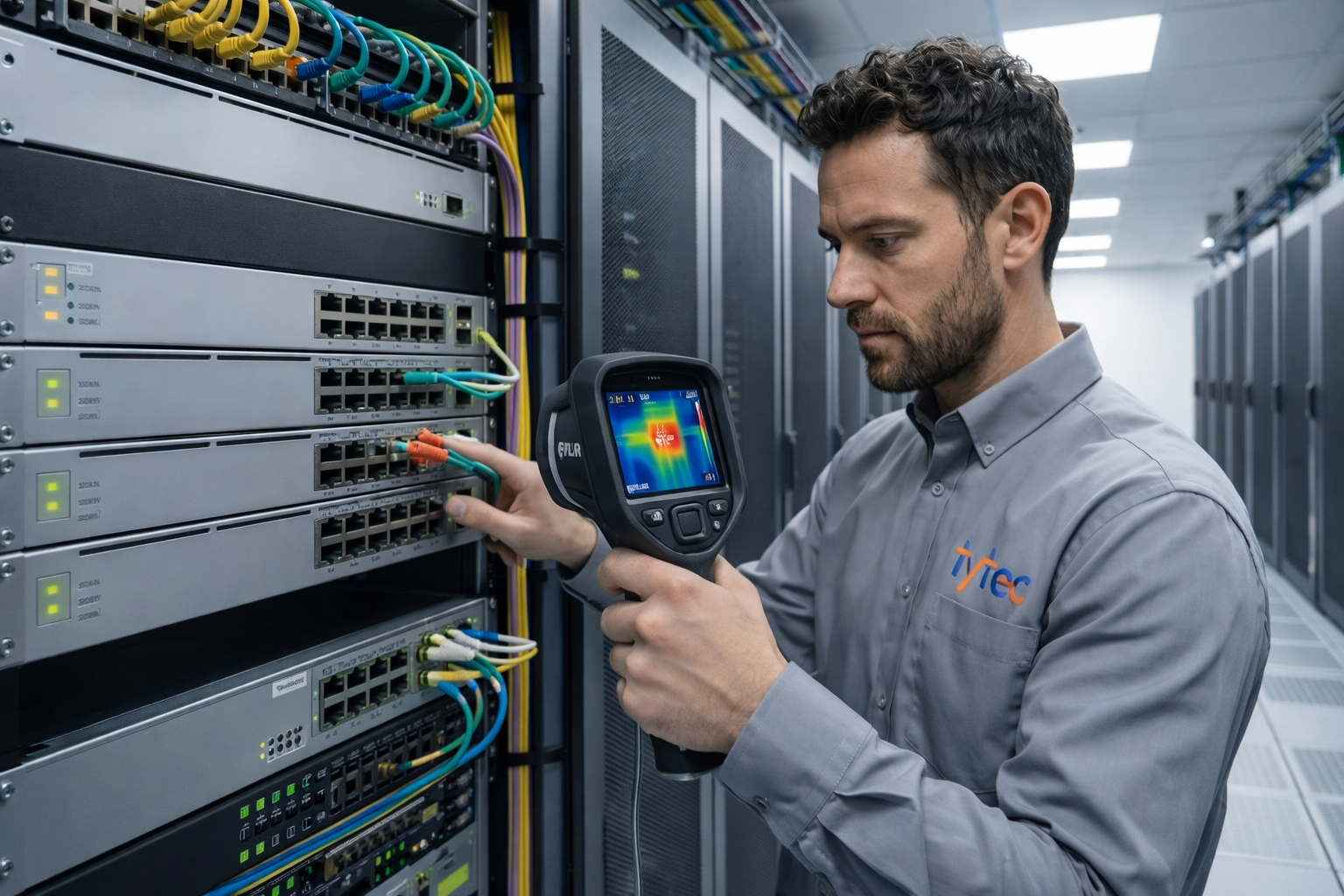
Remote hands technicians are frequently asked to confirm the state of equipment, check LED indicators, verify connectivity, or provide visual confirmation. People often call this ‘eyes on glass’, but in practice, it’s much more than that.
By physically inspecting systems, remote hands remove uncertainty. Instead of relying on assumptions or incomplete telemetry, your team receives accurate, real-time information. This significantly reduces troubleshooting time and allows faster decision-making.
Immediate Response: Reboots and Power Cycling
Despite modern remote management tools, manual intervention remains required. Systems can become unresponsive, remote access may fail, and automated recovery processes don’t always work as intended.
In these situations, remote hands services provide immediate action.
Rebooting a server or power cycling a device may appear simple, but the impact is significant. Without local access, teams can delay these tasks for hours. With remote hands, they complete these tasks within minutes.
This is a clear illustration of how round-the-clock data center support can significantly reduce downtime. The value isn’t in complexity, but in speed and availability.
Cabling and Connectivity: Where Small Errors Become Big Problems
Cabling remains one of the most common sources of issues in data center environments. In high-density racks, a single incorrect connection can affect multiple systems.
Remote hands technicians regularly handle repatching, cable tracing, and connectivity adjustments. These tasks require precision, particularly in modern environments where infrastructure is becoming more complex.
As explored in our article on AI-driven remote hands in Nordic data centers, increasing rack density and advanced workloads mean that physical layer accuracy is more important than ever.
In this context, remote hands aren’t just executing tasks; they maintain the integrity of the entire system.
Hardware Installation and Replacement
Another core part of data center remote hands services is hardware handling. This includes installing new equipment, replacing failed components, and supporting infrastructure upgrades.
Rack and stack deployments are a regular part of daily operations. Technicians receive, mount, connect, and prepare for use equipment according to client specifications. Every step must be executed correctly to ensure performance and reliability.
When hardware fails, remote hands technicians perform replacements quickly and safely. Whether it’s a storage device, power supply, or network module, the objective remains the same: restore full functionality with minimal disruption.
Supporting Remote Engineering Teams
Remote hands don’t replace your engineers; they enable them.
In practice, they act as the physical interface for your remote team. Engineers diagnose issues and provide instructions, while technicians execute those instructions on-site. This creates a seamless workflow between remote expertise and local execution.
For organizations managing infrastructure across multiple regions, this model is essential. It allows full control over systems without requiring a permanent on-site presence.
This is particularly relevant for companies scaling infrastructure into Sweden, where physical distance would otherwise introduce delays and operational complexity.
Logistics, Equipment Handling, and Site Coordination
A significant part of remote hands work happens behind the scenes. Logistics must receive, inspect, document, and position equipment correctly within the data center.
Remote hands technicians manage these processes to ensure smooth deployments and accurate inventory tracking. This includes verifying shipments, labeling assets, and coordinating access within secure environments.
For international clients using colocation remote hands services, this eliminates the need for on-site visits and simplifies infrastructure management across borders.
Preventive Maintenance and Ongoing Support
Not all remote hands work is reactive. A large portion is preventive.
Routine inspections, cable audits, and environmental checks help identify potential issues before they become failures. This proactive approach aligns with TYTEC’s focus on reliability and long-term infrastructure stability.
As noted in our core service approach, most outages stem from small issues that go unnoticed over time rather than major failures.
Preventive remote hands services reduce risk, improve uptime, and maintain operational consistency.
Always Available: 24/7 Data Center Support
Data centers operate continuously, and support must match that reality. Remote hands services are available 24/7, ensuring that requests can be handled at any time.
This is critical for organizations operating across time zones. When an issue occurs, we must take immediate action. We can’t tolerate delays.
With 24/7 data center support, businesses maintain control over their infrastructure regardless of location or time.
The Reality: Simple Tasks, Critical Impact
It’s important to understand that most remote hands tasks aren’t complex. Pressing a button, reconnecting a cable, or verifying a connection are straightforward actions.
However, these actions occur at critical points in your infrastructure.
The value of remote hands lies in speed, precision, and availability. When something needs physical attention, it happens immediately. Zero travel delays, zero scheduling gap, and zero uncertainty.
Why Remote Hands Are Essential in Nordic Data Centers
The Nordic region has become a key hub for digital infrastructure, offering stability, sustainability, and scalability.
However, for many organizations, other countries manage their infrastructure remotely. This creates a physical gap that only software alone can’t solve.
Remote hands services provide the missing layer. They ensure that infrastructure deployed in Sweden or across the Nordics remains accessible, maintainable, and responsive.
How TYTEC Supports Your Data Center Operations
At TYTEC, we design our remote hands services in data centers to integrate directly into your operations.
We provide fast response, precise execution, and clear communication across all tasks. Whether it’s routine maintenance or urgent intervention, our technicians act as a reliable extension of your team.
Our focus isn’t on generic support. It’s about delivering consistent, high-quality execution in environments where uptime is critical.
Ready to Reduce Downtime and Operate Without Limits?
If your infrastructure depends on fast response, reliable execution, and local expertise, remote hands services aren’t optional; they’re essential.
TYTEC delivers data center remote hands services across Sweden and the Nordic region, giving you immediate physical access to your infrastructure without the cost and delay of travel.
Whether you need ongoing support, rapid response, or full deployment assistance, we provide the on-site capability that keeps your systems running.
Contact TYTEC today to discuss your requirements and ensure your infrastructure always has the support it needs.