

Inside a Certified Structured Cabling Installation: How TYTEC Tests, Documents, and Registers Every Siemon System
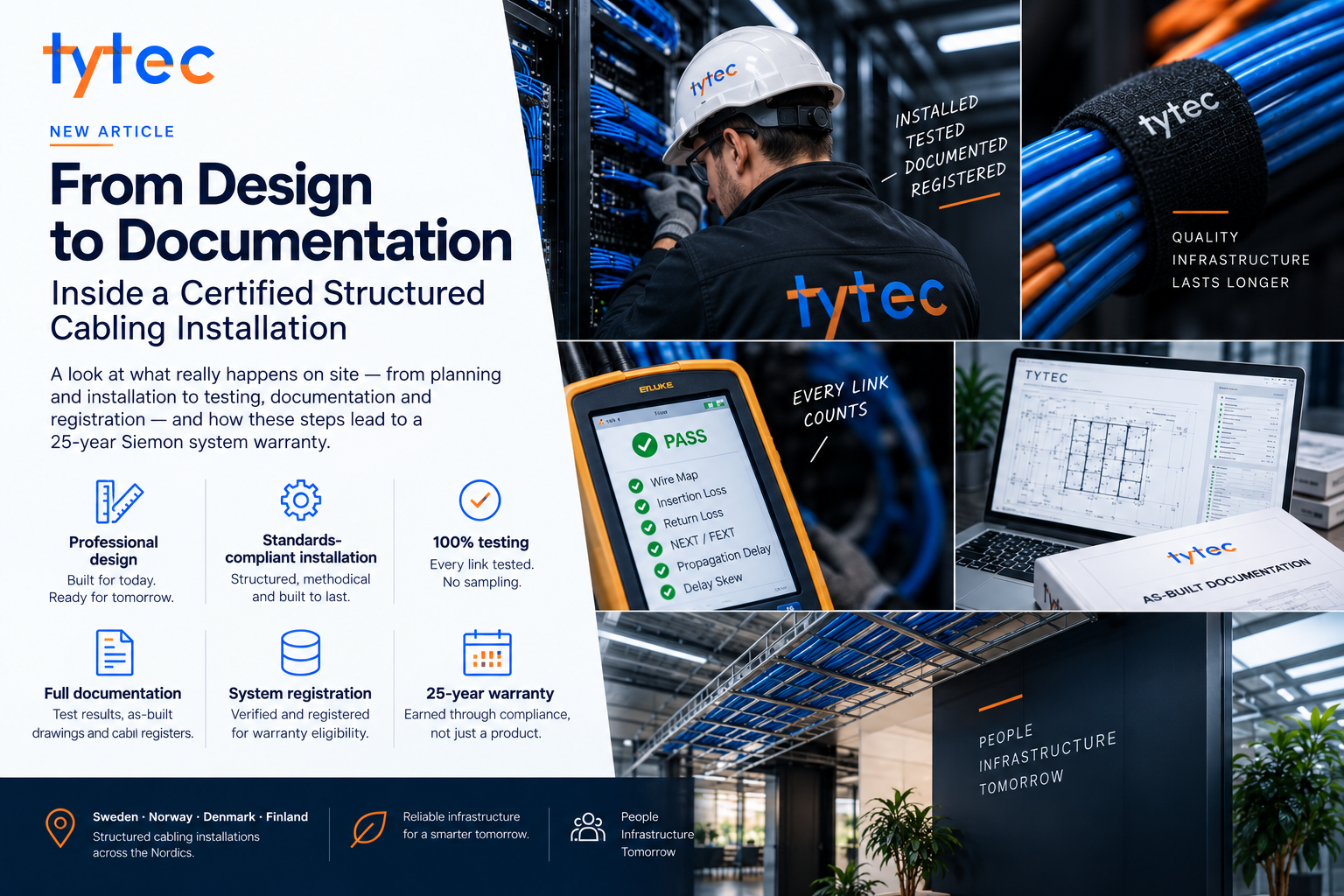
When TYTEC announced our Siemon Certified Installer status, the most common question we received was a practical one: what changes on site?
It’s a fair question. Certification is easy to describe as a credential and harder to describe as a process. Yet the difference between a certified structured cabling installation and an uncertified one isn’t a logo on a quotation. It’s a sequence of measurable, documented steps that take place before, during, and after the cable is installed, and it’s those steps that make a 25-year Siemon system warranty possible.
This article walks through that process: what certified installation involves, why testing and documentation carry so much weight, and what organizations across Sweden and the Nordics should expect from structured cabling work intended to last decades.
A 25-Year Warranty Is Earned, Not Issued
People persistently assume that a manufacturer’s warranty is something a customer buys. In structured cabling, it’s something an installation qualifies for.
Siemon doesn’t apply its 25-year system warranty automatically because Siemon components are used. Installers must design the system according to the manufacturer’s specifications, install it with a certified installer, test it to the relevant performance standard, document it in full, and submit it to Siemon for registration and review. If the test results fall below the required thresholds, the system fails to qualify until the deficiencies are corrected and retested. This process repeats until the link passes. Nothing is left behind.
The distinction matters. The warranty functions as evidence of installation quality rather than insurance against poor workmanship: an organization holding a registered Siemon system warranty holds proof that a qualified party verified its structured cabling against a defined standard.
For anyone evaluating infrastructure suppliers, that suggests a direct question: will you register this installation, and will I receive the test results?
Design Decisions Made Before the First Cable Is Pulled
Certified installation begins at the design stage, well before anyone arrives on site.
The component set has to be coherent. Cables, patch panels, outlets, connectors, and patch cords all need to come from a matched system rather than being assembled from whatever is available. The weakest element in the link determines channel performance in a structured cabling system, and mixing components from different manufacturers undermines both performance and warranty eligibility.
Pathway and containment planning follow. Bend radius, separation from power cabling, fill ratios, and support intervals all influence long-term performance. A cable that a cable tie has over-tightened or that a worker has pulled around too sharp a corner may pass a test on the day of installation and degrade over subsequent years.
Then, capacity comes up. A system installed in 2026 should still serve the building in the 2040s. This means planning for device growth, choosing whether Cat6A is the right copper specification, and deciding how much dark fiber to place in the backbone while the pathways are still open. Retrofitting capacity later is always more expensive.
These decisions are where certified installers earn their value. The installation work is visible; the design judgment behind it usually isn’t.
Testing: Where Structured Cabling Shines
Every permanent link in a certified installation is tested. Not a representative sample, every link.
Copper testing uses a calibrated field tester configured for the correct standard and link definition, measuring wire map, insertion loss, return loss, near-end and far-end crosstalk, propagation delay, and delay skew. A link either passes against the specified performance category or it doesn’t. Results sitting close to the threshold are worth investigating rather than accepting, since marginal links cause the intermittent faults that appear once the network carries live traffic.
Fiber testing follows the same discipline. Tier 1 certification measures insertion loss, length, and polarity. Tier 2 adds OTDR traces, which characterize each event along the fiber connectors, splices, and bends, and reveal problems a simple loss measurement conceals. For data center backbones and high-speed links, OTDR testing is worth specifying rather than treating as optional.
Test equipment must be within its calibration period for results to be valid for warranty submission, a genuine requirement, and one of the more common reasons for delayed registration submissions.
The output is a complete set of test results for the installed system. Those results are the technical basis on which the warranty rests.
Documentation: The Part That Pays Off Years Later
Documentation is the least glamorous element of a certified structured cabling installation and, over a twenty-five-year service life, arguably the most valuable.
A properly documented system includes consistent labeling applied to both ends of every link, following a defined convention that matches the records. It includes as-built drawings showing routes rather than the design intent. It includes a port-to-port schedule mapping every outlet to its patch panel position. It includes the full test result set, exported in the tester’s native format, so that the underlying measurement data preserves and can be reopened later.
The value becomes obvious the first time a fault occurs. A technician with accurate labeling and a current schedule isolates the problem in minutes. Without documentation, the same technician may spend hours tracing cables through ceiling voids and risers in a live environment where access is limited and disruption is costly.
Documentation also protects the organization commercially. When a building changes hands, when an IT team turns over, or when a warranty claim arises, the records establish what was installed and how it performed at handover. Undocumented infrastructure is, in practice, unknown infrastructure.
Registration and What Happens Afterwards
Once installation and testing are complete, TYTEC compiles the submission for Siemon: system design details, component schedules, installer credentials, and the full-test results. Siemon reviews the submission and, where the system meets the requirements, issues the warranty certificate covering the installed system for twenty-five years.
That certificate belongs to the customer; they should store it with the building’s infrastructure records alongside the as-built documentation and test files.
What the warranty covers is worth understanding precisely. It applies to the performance of the installed system, including components and workmanship, but not to damage caused by subsequent uncertified alterations. This is where many otherwise well-managed systems lose protection: an ad hoc addition made months later by an uncertified party can compromise the registered system.
Once a party registers a system, they should carry out later moves, adds, and changes to the same standard, matched components, tested and documented in the same way, and recorded against the original system. Certified infrastructure is maintained as a system, not as a collection of cables.
Why This Matters for Nordic Data Centers and AI Infrastructure
AI and high-performance computing environments concentrate enormous quantities of fiber into compact spaces. Link budgets are tighter, connector counts are higher, and the consequences of a marginal link scale with the value of the workload running across it. In a high-density deployment, an underperforming connector identified by OTDR during commissioning is a minor correction. The same connector discovered six months later, under load, is an operational incident.
This is why testing discipline and documentation quality matter more in data center environments than anywhere else. Density amplifies every installation decision, positive or negative, and making full use of the Nordic region’s power and cooling advantages requires a physical layer built and verified to match.
Planning a Structured Cabling Project?
Whether the project involves a new data center hall, an office relocation, a fiber-optic backbone upgrade, or an enterprise network refresh, the questions worth asking your installer are consistent: Will every link be tested? Will I receive the results? Will technicians register the system for warranty? Will technicians give me as-built documentation and a port schedule?
TYTEC is a Siemon Certified Installer, delivering qualifying structured cabling installations backed by a 25-year Siemon system warranty across Sweden and the Nordic region. We design, install, test, certify, document, and register the systems we deliver, and we hand over the evidence.
If you’re planning a structured cabling project, data center deployment, fiber-optic installation, or network upgrade, we would be glad to discuss the requirements with you.
Frequently Asked Questions
What does a Siemon Certified Installer do differently?
A certified installer designs to the manufacturer’s specification, uses a matched component system, tests every permanent link with calibrated equipment, produces full documentation, and submits the completed system to Siemon for warranty registration.
How is a 25-year structured cabling warranty obtained?
One obtains it by qualification, not purchase. The installed system must pass the required performance testing and register with and get approval from Siemon.
Does every cable get tested, or only a sample?
Every permanent link is tested. Sample testing doesn’t meet certification requirements.
What is the difference between Tier 1 and Tier 2 fiber testing?
Tier 1 measures insertion loss, length, and polarity. Tier 2 adds OTDR traces that characterize events along the fiber, such as connectors, splices, and bends.
Can changes occur after registration of the system?
Yes, provided technicians carry out changes to the same standard using matched components, then test, document, and record against the original system. Uncertified alterations can compromise warranty coverage.
Does TYTEC provide structured cabling for data centers?
Yes. TYTEC delivers data center cabling, fiber-optic backbone infrastructure, and high-density installations for AI-ready environments across Sweden and the Nordics.